
Comprehensive Treatment Solution for Oily Wastewater from Lithium Battery Production
Against the backdrop of the accelerating global energy-structure transition and the 'dual-carbon' goals, the lithium battery industry has experienced explosive growth. As the core of new-energy vehicles and energy-storage systems, lithium battery production is under unprecedented environmental scrutiny. Especially in key processes such as electrode coating, electrolyte filling, and equipment circulating cooling, large volumes of complex, highly stable oily wastewater are generated. This wastewater contains not only emulsified oil and mineral oil but also NMP (N-methyl-2-pyrrolidone), PVDF binder, conductive agents, and trace heavy-metal ions such as lithium, cobalt, and nickel.
Traditional physicochemical or biochemical methods often face pain points such as difficult demulsification, large fluctuations in effluent quality, and frequent membrane fouling. How to ensure stable compliant discharge while achieving a high reuse ratio of water resources has become a technical barrier that lithium battery manufacturers urgently need to overcome. Targeting this common industry problem, SINOKLE, drawing on years of industrial wastewater treatment experience, has launched a customized solution integrating efficient separation, deep purification, and resource recovery, aiming to drive the green upgrading of the lithium battery industry through technological innovation.
I. Analysis of Treatment Difficulties
The reason lithium battery production wastewater is classified as difficult-to-treat industrial wastewater mainly lies in its unique physicochemical properties:
Difficulty in oil-water separation
Because large amounts of surfactants and organic solvents are added during production, a large quantity of emulsified oil with extremely small particle sizes forms in the wastewater. This emulsified system is extremely stable; traditional oil-separation tanks or ordinary flotation processes can hardly break it effectively, causing the petroleum-class index in the effluent to remain high.
Complex composition with large fluctuations
Besides oil, the wastewater also contains high-concentration COD, suspended solids, and biotoxic heavy-metal ions. The presence of organic solvents such as NMP poses severe challenges to subsequent biochemical or membrane treatment; the slightest negligence can paralyze the entire treatment system.
Dual pressure from discharge standards and reuse demands
With the implementation of the 'Discharge Standard for Pollutants from Battery Industry' (GB 30484), environmental authorities in various regions are increasingly strict on limits for petroleum substances and COD. Meanwhile, under the policy orientation of water conservation and consumption reduction, enterprises urgently need to reuse treated wastewater in cooling, cleaning, and other processes, which requires the treatment process to have extremely high advanced-treatment capability.
II. Core Process Route and Technical Advantages
In view of the specificity of lithium battery wastewater, SINOKLE has abandoned the single-treatment model and built a full-process closed-loop process of 'enhanced pretreatment - deep purification - resource reuse.' This process not only solves the persistent problem of difficult emulsified-oil separation but also achieves resource conversion of pollutants.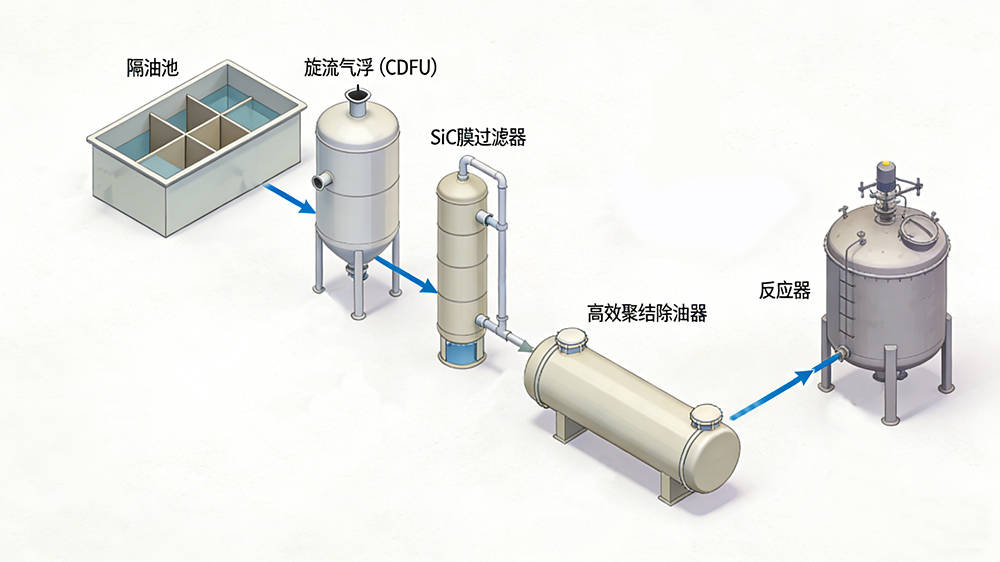
Multi-stage collaborative pretreatment: demulsification and solid-liquid separation
The front end of the process adopts 'CDFUcyclonic dissolved-air flotation' as a combined process. The centrifugal force field generated by cyclonic flow enables rapid pre-separation of light and heavy liquid phases; then, using micro-nano bubble generation technology, a large number of uniform and dense bubbles (diameter 5-30 um) are produced, which efficiently adhere to the emulsified oil and suspended solids in the water and rapidly float to the surface to be scraped off.CDFUThe single-stage oil-removal efficiency can exceed 90%, greatly reducing the load on the subsequent treatment system and effectively avoiding equipment fouling.
KFM active-filter-media filter: deep purification and interception
Building on pretreatment, the system introduces the KFM active-filter-media filter. This filter uses silicate-based media modified by atomic deposition technology, achieving efficient purification of oily wastewater through a triple mechanism of super-hydrophilic nano-structure, negative-charge adsorption, and physical interception. For the unique organic components in lithium battery wastewater, the media surface is specially modified to significantly improve anti-fouling ability and filtration precision. Through precise screening, the system efficiently intercepts residual colloids, macromolecular organics, and suspended solids, ensuring clear and transparent effluent. KFM filter outlet indicators can reach: oil content <= 6 ppm, suspended solids <= 2 mg/L, median particle size <= 1.5 um.
Coalescing separation polishing: ultimate capture of micro oil droplets
To deal with trace residual emulsified oil after pretreatment, the process chain specially installs the KHC coalescing oil-water separator. When oily water flows through the specially designed coalescing cartridge, the cartridge's internal oleophilic-hydrophobic medium induces inertial collision and coalescence of tiny oil droplets. The originally dispersed micrometer-scale droplets gradually merge into millimeter-scale large droplets, which then automatically float and separate in the separation chamber by density difference. This physical process requires no large amounts of chemicals and achieves efficient oil-water separation, serving as the final barrier to ensure the effluent oil content meets standards.
Resource Recovery and Circular Economy
This solution adheres to the design philosophy of 'treating waste with waste and turning waste into treasure.' The separated waste oil has low water content and high purity, and can be directly entrusted to qualified units for resource utilization or used as fuel-oil feedstock, generating certain economic value. Meanwhile, the deeply treated product water is of excellent quality and can be reused according to customer needs in non-critical process links such as workshop floor cleaning and circulating cooling make-up water, with a reuse rate of up to over 90%, greatly reducing the enterprise's fresh-water intake and discharge costs.
Intelligent Control Platform
The entire system is integrated into an advanced PLC/DCS automated control platform. Through online instrumentation distributed throughout the system, key parameters such as pH, conductivity, turbidity, and flow are collected in real time. The built-in intelligent algorithms achieve precise dosing control, dynamic energy-consumption adjustment, and early fault warning. Operators can complete full-process monitoring and remote operation and maintenance from the central control room, truly realizing unattended or minimally-staffed operation and significantly reducing manual-operation risks and management costs.
Summary of Technical Indicators
Item | Influent indicator | Effluent indicator |
Petroleum substances (mg/L) | ≤1000 | ≤10 |
Suspended solids (mg/L) | ≤1000 | ≤20 |
COD (mg/L) | ≤4000 | ≤100 |
III. Conclusion: Supporting the Sustainable Development of the Lithium Battery Industry
As global attention to carbon emissions continues to rise, the environmental threshold of the lithium battery industry will keep increasing. The oily wastewater treatment solution provided by SINOKLE not only effectively solves the environmental pain points in lithium battery production and ensures that enterprises calmly cope with environmental inspections, but also helps enterprises reduce operating costs and improve their ESG ratings through water-resource recycling and pollutant reduction.
Choosing this solution means choosing a more efficient, economical, and greener industrial production model. SINOKLE will continue to deepen its work in the industrial wastewater treatment field, safeguarding the green mountains and clear waters through technological innovation, and helping lithium battery enterprises advance steadily and far in global green competition.

